Review: The Winter’s Tale (The National Ballet of Canada)
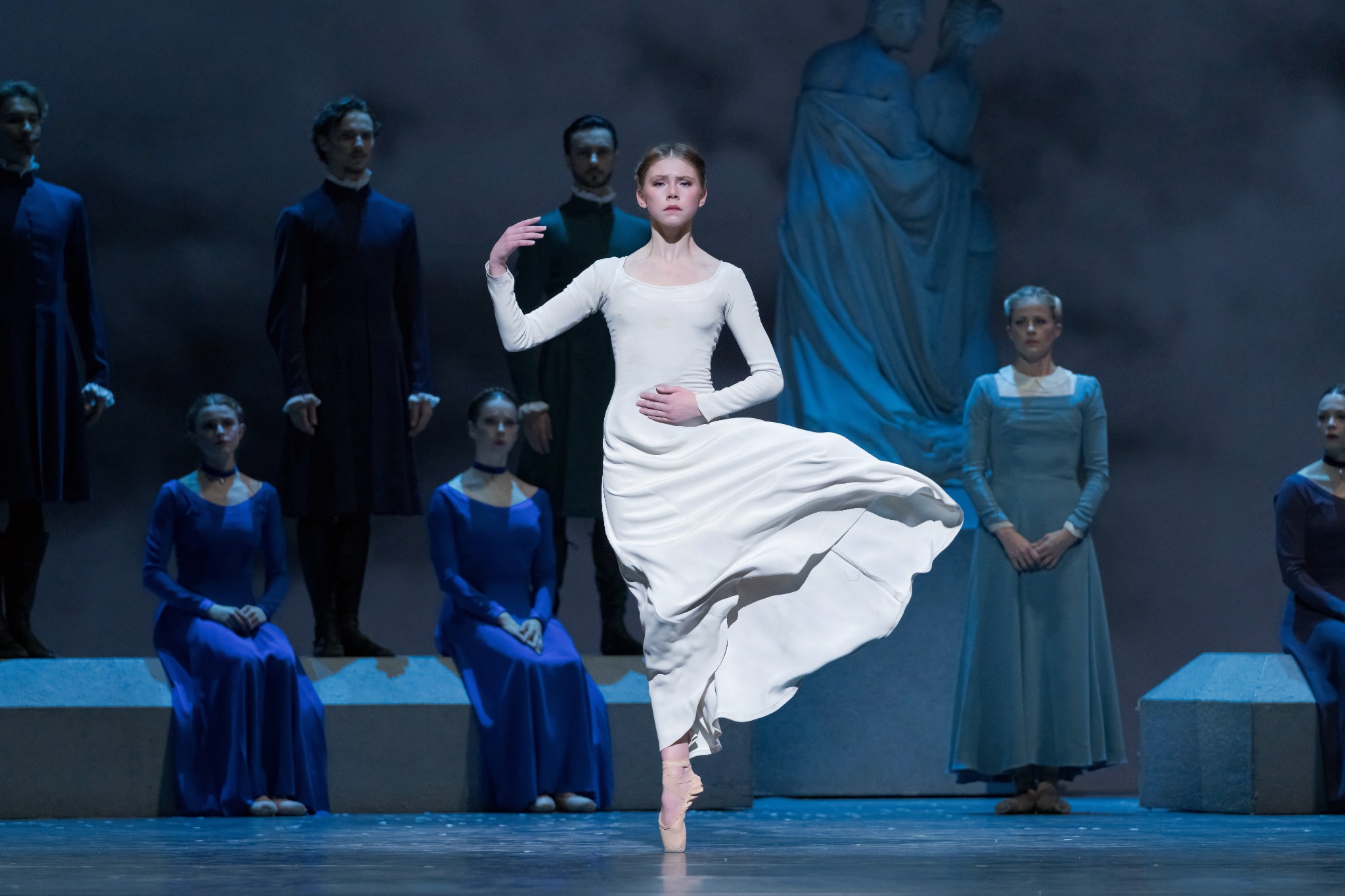
Christopher Wheeldon’s The Winter’s Tale returns to the National Ballet of Canada in a brilliant revival that showcases the company at its best and stands out as my favourite Wheeldon production to date. Adapted from Shakespeare’s play of the same name, this ballet compresses the original five acts into three, clearly establishing the tone and narrative framework of an emotionally heavy and tangled story.
The first act of the ballet introduces the close childhood bond between Kings Leontes (Ben Rudisin) and Polixenes (Donald Thom), a relationship Wheeldon makes especially clear through an added prologue. The ensemble appears in black, while the two future kings begin as children wearing bright red and green. They playfully handle their crowns before transitioning through smooth choreography into their adult counterparts. This sequence quickly establishes their shared history and identities before the story shifts into the stark world of Sicilia.
Once in Sicilia, the tone darkens as Leontes becomes convinced that his pregnant wife Hermione (Isabella Kinch) has been unfaithful with his childhood friend. Ben Rudisin anchors the act, tracing Leontes’ unraveling with precise physical detail: the jealousy first shows itself in his fingers before tightening through his entire body. His growing suspicion is punctuated by flashes of green lighting and intrusive, physicalized thought sequences. His accusation sets off the tragedy that follows: their son Mamillius (Lyon Kilpatrick) collapses under the strain of a trial, and their newborn daughter, Perdita (Tirion Law), is abandoned and sent off to Bohemia.
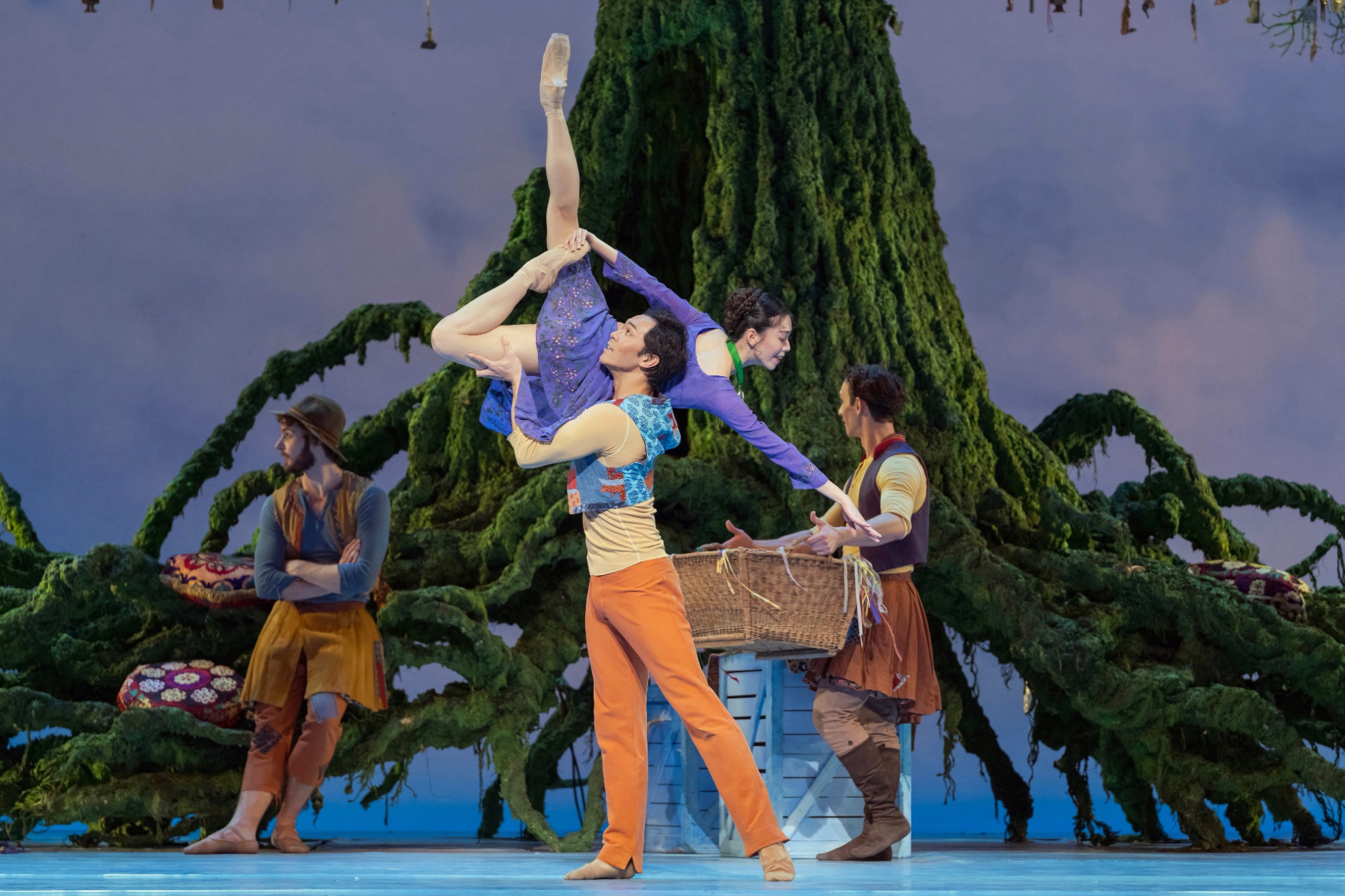
The second act shifts to Bohemia years later, where Perdita, now raised by a shepherd’s family, has grown into a young woman who falls in love with Florizel (Naoya Ebe), the son of Polixenes. Here the ballet moves into a whimsical springtime festival, a complete contrast to Sicilia’s severity. A huge wishing tree covered in more than 2,000 handmade ornaments fills the stage, creating a bright green focal point for the community celebration.
Much of this act centres on the warm, affectionate connection between Perdita and Florizel, supported by a corps de ballet that moves through fast footwork and circular patterns to keep the festival atmosphere lively. A clever theatrical moment arrives when a cloud-like sheet transforms into a ship, flipping again into a second ship as the group travels toward Sicilia. Together, these elements build a world that feels joyful, open and full of action, offering great contrast to the darkness of Act I.
The final act returns the story to Sicilia and blends the two worlds together as the consequences of Leontes’ actions resurface. The story moves toward reconciliation as Leontes confronts the losses and consequences he has caused. This act settles into a quieter and more reflective tone, with pale blues and whites in the costuming giving the scenes a softer, almost suspended feeling.
Ben Rudisin returns with a subdued physicality as Leontes, dancing moments of grief and remorse that contrast sharply with the force of his Act I unraveling. The emotional centre of the final act is guided by Heather Ogden as Paulina, a steadfast and strong female figure in the work, who serves as the story’s moral compass.
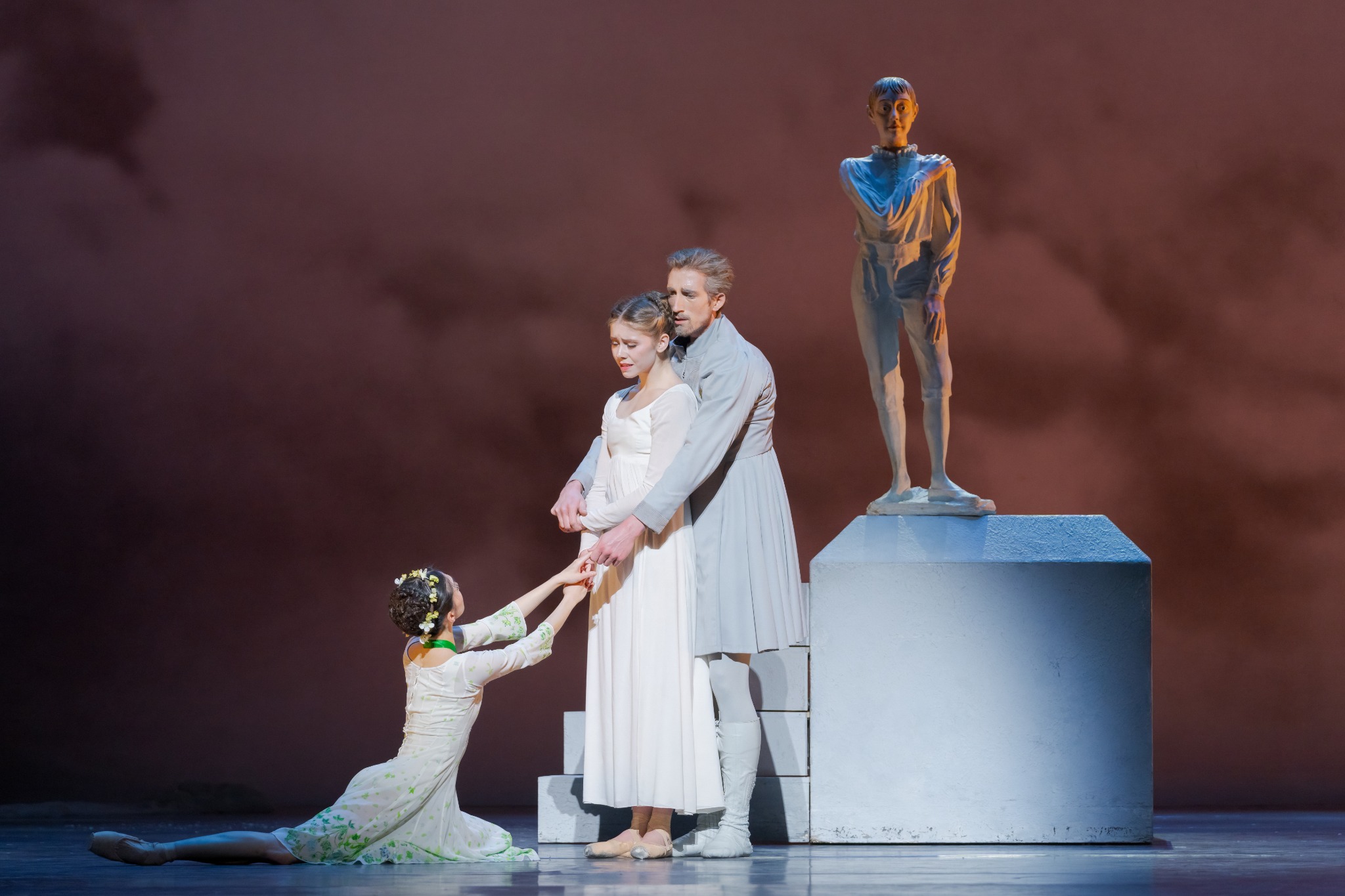
What stands out most in this production is how clearly Wheeldon navigates the complexity of the story. The shifts between Sicilia and Bohemia are communicated not only through his direction and choreography but through the design team’s attention to detail in each world. Bob Crowley’s sets and costumes, Natasha Katz’s lighting, and Daniel Brodie’s projections establish immediate and readable contrasts, giving the narrative strong visual anchors. Basil Twist’s silk effects add an inventive layer, including a clever interpretation of Shakespeare’s famous “Exit, pursued by a bear” that keeps the moment theatrical without breaking the ballet’s tone. Joby Talbot’s score also brilliantly supports this clarity throughout, underscoring the emotional textures of each act and scene.
The casting also strengthens this revival, introducing a few new faces that signal an exciting season ahead. Isabella Kinch offers a soft and sincere Hermione in her debut, grounding the character with believable warmth and underlying pain. Her counterpart, Ben Rudisin, is a standout as Leontes, bringing intense passion and clear storytelling to the role from his first gesture through to his full emotional collapse. In Bohemia, Tirion Law and Naoya Ebe bring warmth and ease as Perdita and Florizel, giving the act its tender emotional core. And although not a central figure, Albjon Gjorllaku is especially memorable as Brother Clown, the shepherd’s son, bringing a strong charismatic energy and clean technical skill without ever overshadowing the central couple.
Overall, The Winter’s Tale succeeds across choreography, design, and performance, offering a production that feels fully considered in every detail. With strong dancing and detailed staging throughout all three acts, it’s a compelling revival that leaves a lasting impression, and it is unquestionably worth experiencing at the Four Seasons Centre. Get your tickets!
The Winter’s Tale, presented by the National Ballet of Canada at the Four Seasons Centre for the Performing Arts (145 Queen St W, Toronto, ON M5H 4G1), is playing until November 21st, 2025. For tickets, please click here.
National.Ballet.ca | Socials: @nationalballet
- Photo 1: Isabella Kinch with Artists of the Ballet in The Winter's Tale. Photo by Karolina Kuras. Courtesy of The National Ballet of Canada.
- Photo 2: Tirion Law and Naoya Ebe in The Winter's Tale. Photo by Karolina Kuras. Courtesy of The National Ballet of Canada.
- Photo 3: Tirion Law, Isabella Kinch and Ben Rudisin in The Winter's Tale. Photo by Karolina Kuras. Courtesy of The National Ballet of Canada.
Written by Deanne Kearney | DeanneKearney.com @deannekearney
0 Comments Add a Comment?